How to use a compass: bearings, back-bearings, and staying on course
Take a bearing, walk it accurately, and get yourself back again. The complete beginner's method, written for both a baseplate compass and a phone.
8 min read · updated
A compass answers exactly one question: which way am I pointing? Everything else in navigation, whether following a route, relocating a path, or walking out of fog in a straight line, is built from that single answer plus a bit of arithmetic. This guide covers the whole method, from reading a heading to walking a bearing across featureless ground.
Try the steps with the live online compass. If the dial jumps, check the phone compass calibration guide before following a bearing.
Reading a heading
A heading is the direction the front of you is pointing, measured clockwise from north in degrees. North is 0°, east 90°, south 180°, west 270°. Anything between gets a number: 135° is southeast, 315° is northwest.
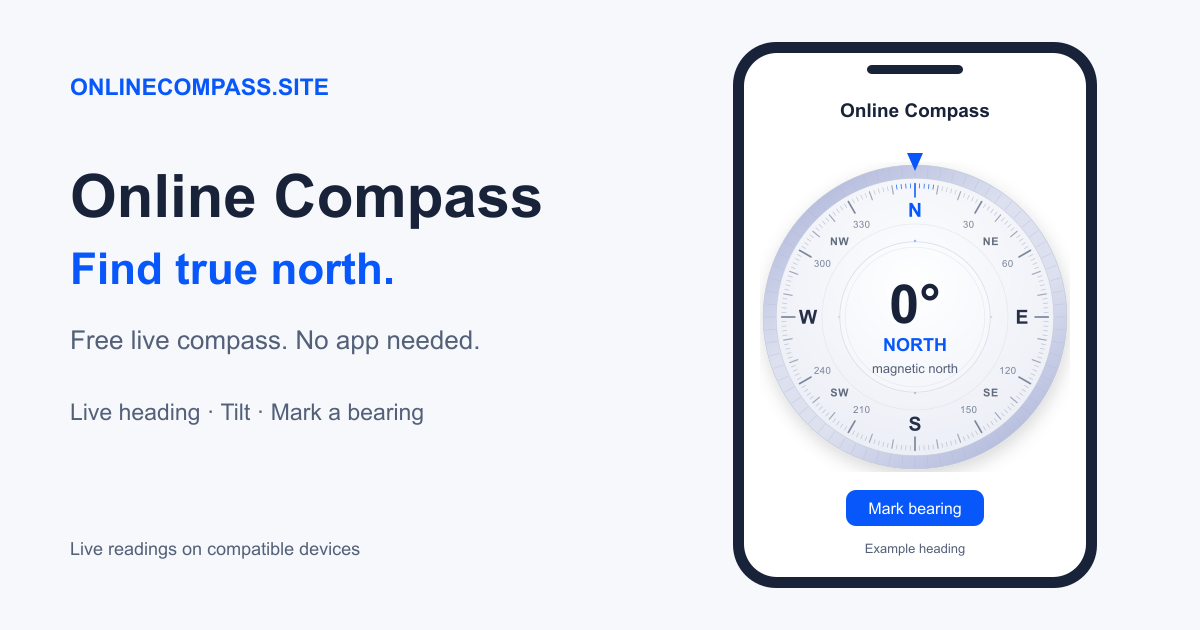
On a phone, hold the device flat with the screen up and the top edge pointing the way you want to measure. The number in the middle of the dial is your heading. Turn your whole body rather than twisting your wrist. A tilted phone reads a projection of the magnetic field rather than the field itself, and errors of ten or fifteen degrees creep in fast.
On a baseplate compass, point the direction-of-travel arrow at your target, then rotate the bezel until the orienting arrow sits underneath the red end of the needle. Climbers call this “put red in the shed”. Read the number at the index line.
Taking a bearing to something you can see
Suppose you can see a distant col, tower, or rock outcrop and you want to walk to it. Point at it, read the heading, and write it down. That number is now independent of visibility: if cloud rolls in five minutes later, the bearing still gets you there.
- Face the target squarely and read the heading.
- Note it down with a label, e.g. “col 072°”.
- Pick an intermediate feature on that line, a boulder or a distinctive tree, walk to it, then re-check and repeat.
The last step matters more than people expect. Nobody walks in a straight line over rough ground; almost everyone drifts consistently to one side. Leapfrogging between near objects on the bearing removes the drift instead of accumulating it.
Back-bearings: retracing your steps
A back-bearing is the reverse of a bearing: add 180° if the number is under 180, subtract 180° if it is over.
- Walked out on 072°? Walk home on 252°.
- Walked out on 310°? Walk home on 130°.
Back-bearings are also how you check you are still on the line. Turn around, sight back at the feature you left, and confirm it reads as the back-bearing. If it reads 262° instead of 252°, you have drifted ten degrees and you can correct now instead of arriving a kilometre off.
The one-in-sixty rule
For every degree you are off course, you land roughly one unit sideways for every sixty units travelled. One degree of error over 6 km puts you 100 m off. Five degrees over 6 km puts you 500 m off. That is the difference between finding a bothy and walking past it.
This is the reason a “good enough” compass reading is not good enough on a long leg, and the reason to break long legs into short ones with a checked bearing at each step.
Aiming off deliberately
When your target sits on a line such as a stream, a wall, or a track, do not aim at the target. Aim ten degrees to one side on purpose. When you hit the line you know without ambiguity which way to turn. Aiming exactly at a point leaves you standing on a wall with no idea whether the gate is left or right.
Handrails, catching features, and attack points
Skilled navigators lean on the terrain and save the compass for the parts that need it.
- Handrail. A linear feature running roughly your way (a fence, a forest edge, a river). Follow it and you barely need a bearing at all.
- Catching feature. Something unmissable beyond your target that tells you that you have gone too far.
- Attack point. An obvious feature near your target. Navigate loosely to the attack point, then take one short, careful bearing from there.
Using a phone as your compass
A phone magnetometer can give a useful heading when calibrated and away from interference. Its accuracy depends on the device and surroundings. Keep it clear of the things that ruin it:
- Magnetic phone mounts, wallet cases, and MagSafe accessories.
- Car dashboards, bike handlebars, and steel-framed rucksacks.
- Reinforced concrete, railings, and overhead power lines.
Step several metres away from anything metal, hold the phone flat, and give it a figure-eight wave before you trust a reading. Then cross-check: does the heading agree with where the sun should be at this hour? A compass that disagrees with the sky is a compass that is lying to you.
Carry a backup
A phone compass and a baseplate compass fail in completely different ways, which makes them a good pair. The phone dies when the battery does; the baseplate never does. The baseplate cannot tell you your position; the phone can. In serious terrain, carry both and treat agreement between them as your confidence check.
Open the online compass to practise reading and marking a bearing on a compatible phone.
Frequently asked questions
How do I read a compass bearing?
Point the top of your phone or the direction-of-travel arrow at your target, then read the angle clockwise from north. North is 0°, east 90°, south 180°, and west 270°.
How do I find a back-bearing?
Add 180° to a bearing below 180°, or subtract 180° from a bearing above 180°. For example, the back-bearing of 72° is 252°.
Can I use a phone instead of a baseplate compass?
A compatible phone can show a live heading, but nearby magnets, metal, sensor calibration, and battery life affect its usefulness. Carry a physical compass for serious outdoor navigation.