Magnetic vs. true north for Qibla direction
Choose the correct Qibla bearing for a phone compass, baseplate compass, map, satellite image, or building plan.
6 min read · updated
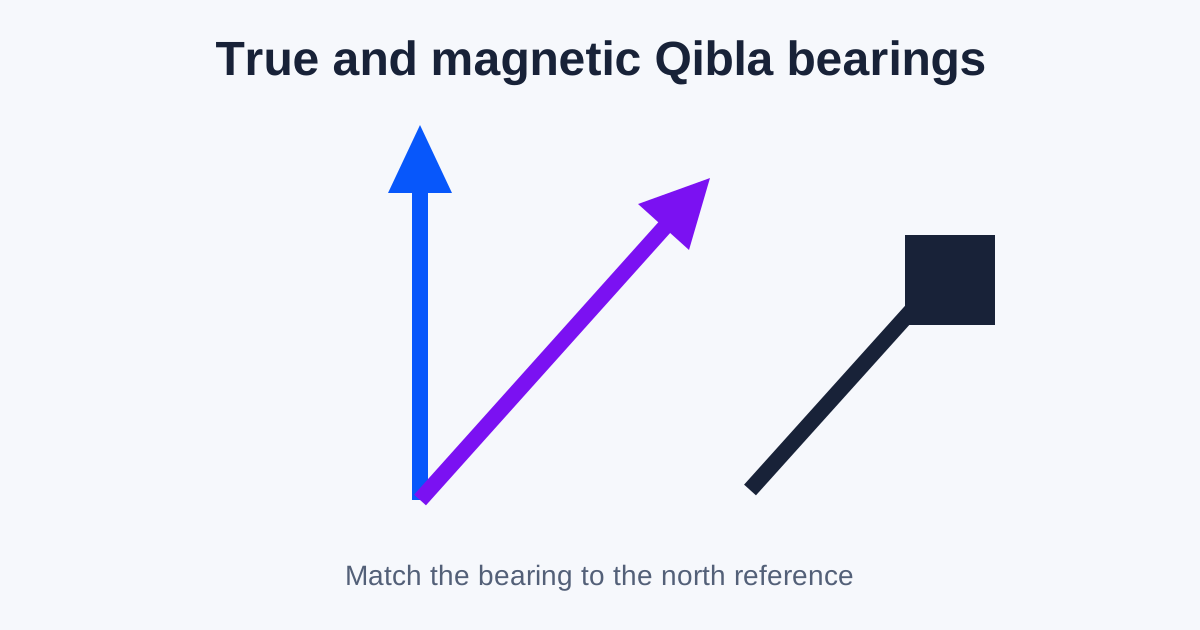
The Qibla has one geographic great-circle direction from a given point, but that direction can be expressed against true north or magnetic north. Use the Qibla finder to see both values for your coordinates.
True Qibla bearing
True bearing measures clockwise from the geographic North Pole. Maps, satellite images, astronomical azimuths, and most building plans use a true or grid reference. A Qibla result of 110° true means turn 110° clockwise from true north.
The great-circle calculation first produces a true bearing. That value changes with your location because the shortest route to the Kaaba starts in a different direction from every point on Earth.
Magnetic Qibla bearing
A traditional compass needle follows the local magnetic field. Magnetic north is separated from true north by magnetic declination. East declination is positive and west declination is negative under the convention used by Online Compass.
To obtain the magnetic bearing a physical compass should read, subtract signed declination from the true bearing. If the Qibla is 110° true and declination is +10°, the magnetic bearing is 100°. Pointing a magnetic compass at 110° in that example would apply the wrong reference.
Phone compass settings
Phones can report magnetic heading, true heading, or a browser orientation stream whose reference varies by platform. Location services may be needed for the operating system to correct magnetic heading to true north.
Read the label in the tool rather than assuming. If a page displays true north, use the true Qibla value. If it displays magnetic north, use the magnetic value. Avoid adding a manual correction to a reading that has already been corrected.
Maps and grid north
Printed maps may use grid north, which follows the vertical grid lines of the map projection. Grid north can differ from true north by grid convergence. A map margin may show the relationship between true, grid, and magnetic north for the sheet.
For ordinary phone-map use, a north-up digital map commonly provides a practical true reference. For surveyed building alignment, use the map's stated reference system and qualified local methods.
Check local declination
The magnetic declination calculator evaluates WMM2025 for your location and date. Declination changes across geography and over time, so an old correction or a value copied from another city can be wrong.
Local steel and electronics can disturb a compass even when the regional declination is correct. Move away from interference, calibrate the phone when needed, and compare with the sun's true bearing as an independent check.
A reliable sequence
- Calculate the Qibla true bearing from accurate coordinates.
- Identify whether your reference is true, magnetic, or grid north.
- Use the matching Qibla value or apply the correct conversion once.
- Check the physical direction with another reference.
Keeping the reference labels attached to each number prevents the most common error: mixing a true Qibla angle with a magnetic compass.
Frequently asked questions
Should Qibla bearing be true or magnetic?
Use true bearing with maps and celestial references. Use magnetic bearing with a physical compass unless that device already corrects to true north.
Why do two Qibla apps show different angles?
They may use different coordinates, north references, Kaaba coordinates, or direction methods. Check whether each result is true or magnetic.
Does magnetic declination change the Qibla itself?
No. The geographic direction to the Kaaba is unchanged. Declination changes how that direction appears on a magnetic compass.